I have always admired a really well-made movie. Just as I immerse myself in well-written literary fiction, I immerse myself in the story and direction of cinema. And I don’t care how true The Catcher in the Rye might be about being aware that these are people acting- telling a lie. I like to see them as representing some truth in ways real-life conversations may not bring out.
And I have discovered that parallel cinema, especially the kind shot in black and white, aims to deliver such soulful art through realism itself, as well as through the depth that monochrome filming can portray. It might not be for everyone. But for those who get a hang of its magic, it stays with them forever.
When I recently watched a Hindi and a Bengali parallel film, I realised what I had been missing for a long time. And it has only made me more curious to explore monochrome movies, particularly non-commercial ones.
Here are my top five recommendations:
Do Bigha Zamin (1953) (Hindi movie)
Bimal Roy’s Do Bigha Zamin is an unforgettable Indian masterpiece.
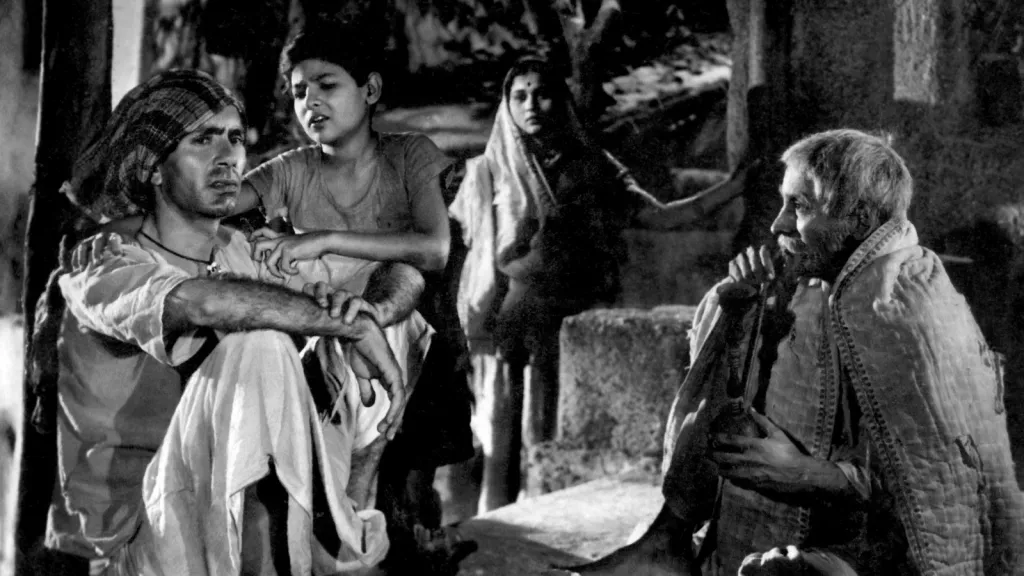
Growing up, I think I had heard of Balraj Sahni and this movie, but I never really paid much attention to either. Recently, however, I heard the film mentioned again in a podcast I was listening to, and I finally decided to watch it.
The film draws inspiration from Rabindranath Tagore’s poem Dui Bigha Jomi and Salil Chowdhury’s short story Rickshawalla. It is regarded as one of the earliest masterpieces of Indian cinematic realism and one of the films that paved the way for what later became known as parallel cinema.
Unlike mainstream commercial cinema, parallel cinema focused on ordinary people and uncomfortable truths.
The film follows Shambhu, portrayed beautifully by Balraj Sahni(you must google him; story of how he died will break your heart).
Shambhu is a poor farmer whose life is turned upside down. It explores poverty, migration and exploitation, depicting a man crushed by circumstances yet unwilling to abandon his principles. That is perhaps the film’s greatest strength.
But the more horrifying truth lies in the fact that the unequal realities of society the film explores still remain with us today.
What also carried me into an entirely different train of thought was the resistance to railways in literature.
The arrival of the railways was not universally celebrated. Many English Romantic writers mourned what industrialization was doing to the countryside. William Wordsworth, who loved the natural world with almost religious devotion, famously opposed railway expansion through England’s Lake District, fearing that untouched landscapes would be sacrificed in the name of progress.
I keep noticing this tension between industrialization and nature in so many works.
We see echoes of it in the book One Hundred Years of Solitude. More recently, I started watching another film on a flight—Train Dreams. I could not finish it because the flight landed, but even in the part I watched, with its stunning cinematography, the railway seemed to symbolize the slow disappearance of untouched landscapes and older ways of living.
And yet I live in a time when railways have connected me to people, places and experiences that would otherwise have remained inaccessible.
How much of what I know today is because someone built those tracks?
I wonder how much have we gained because of the railways? And how much have we lost?
This entire relationship between literature, railways and industrialisation probably deserves an article of its own.
Coming back to Do Bigha Zamin, I find it interesting that a film made over seventy years ago continues to feel so painfully relevant. It speaks about issues that have never really disappeared—they have only changed their appearance.
One of my favourite scenes in the film is when Shambhu’s little son tears up the money he had stolen because he believes that by doing so, God will save his dying mother.
It is something only a child could do. And yet, perhaps we all experience some version of that moment in life.
We spend years chasing something with complete sincerity, believing it to be the answer to all our problems. Then, one day, we are confronted with a larger truth, and suddenly the thing we held so tightly loses all its meaning.
That small scene stayed with me long after the film ended.
Roman Holiday (1953) (English movie)
I do not ever let go of love in my real life. I confess, I accept, and if I am sure of its impact, I fight for it too. But when it comes to literature or movies, some of the most beautiful stories are those that show the nature of restraint in love. Not every love story has a happy ending, and yet some end in separation while still leaving you with a bittersweet nostalgia.
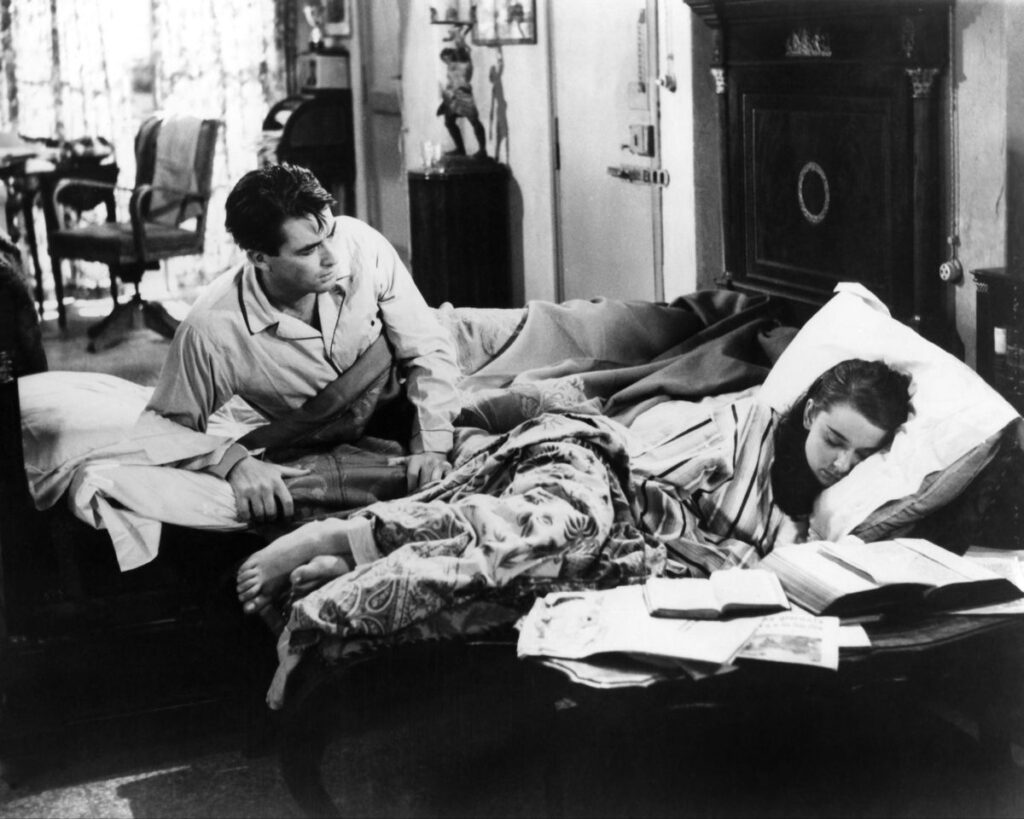
Roman Holiday is one of those films you can watch again and again, simply for the joy of seeing a trapped soul come alive.
Roman Holiday did not have to be black and white. Although colour cinema already existed, director William Wyler chose to shoot the film in black and white, giving Rome a timeless quality. The city never overshadows the romance. Instead, Gregory Peck and Audrey Hepburn seem to live in a world somewhere between dream and reality.
Princess Ann has every privilege imaginable. In many ways, her life is completely different from Shambhu’s in Do Bigha Zamin. Yet, despite all her privilege, she lacks one thing that even a person without wealth or status may still have.
Freedom.
The freedom of not being known. The freedom to move around a city and do what you want without being recognized—to be seen as an ordinary person. Or not to be seen at all. That freedom.
What a paradox, when you compare Shambhu’s life with hers.
But what follows in the movie, born out of this yearning, is a delight to watch. The affection that grows between the two main characters is captivating.
And yet, it is the lingering feeling that this love story is not meant to be that stays with you. More than that, it is the restraint shown by the characters themselves, the maturity with which they let each other go, and the unspoken assurance that the other will be remembered no matter what, that remains the highlight for me.
Charulata (1964) (Bengali movie)
The latest black-and-white film I watched, and perhaps the one that affected me the most, was Charulata, directed by the legendary Satyajit Ray and adapted from Rabindranath Tagore’s novella Nastanirh (The Broken Nest).
To me, Charulata is one of the finest portrayals of loneliness ever filmed. Few films portray loneliness with such restraint. Brokeback Mountain comes to mind for its own portrayal of emotional repression, but Charu’s loneliness is expressed in far subtler, more domestic ways.
It is a film where very little appears to happen, yet everything changes.
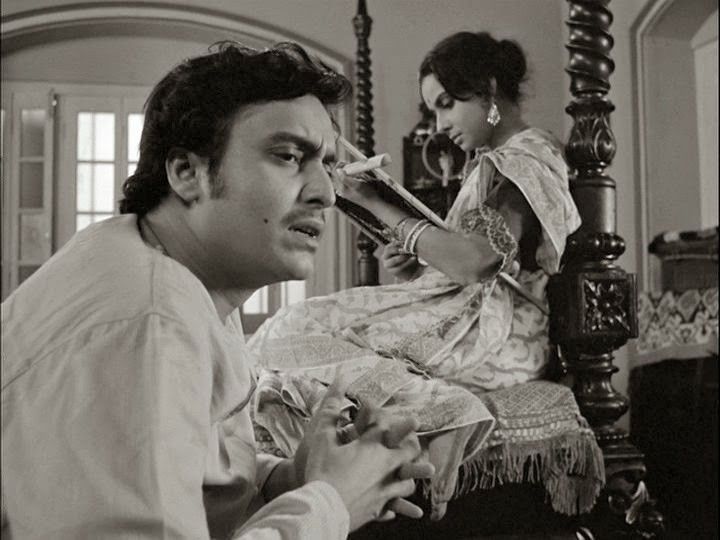
Ray transforms an ordinary Bengali household into an emotional landscape. Every room, corridor, window, and shaft of light seems to carry unspoken feelings. As you watch, you find yourself inhabiting the space inside the screen. It feels as though your soul lingers in its quiet corners, shaded verandas, and gentle gardens. Time itself slows down.
Charu, the intelligent wife of a politically engaged newspaper editor, lives a life of comfort but emotional isolation. Her days pass in quiet repetition until Amal, her husband’s younger cousin: a spirited bachelor with a love for literature, poetry, and art, comes to stay with them.
Their relationship grows not through dramatic declarations, but through shared ideas, unfinished conversations, and silent understanding.
What makes Charulata extraordinary is its restraint. What is going on inside the characters feels obvious, and yet remains open to interpretation.
This movie made me a fan of Satyajit Ray all over again.
And the ending scene is a framed work of art: questions and answers jumbled together into a single moment of hesitation, acceptance, and everything left unsaid.
Pather Panchali (1955) (Bengali movie)
If there is one film that convinced me that cinema can be poetry, it is Pather Panchali. Perhaps it is no surprise that the film went on to receive international acclaim, winning the Best Human Document award at the 1956 Cannes Film Festival.
Directed by Satyajit Ray, yet again, it is not merely a film. It is a meditation on childhood, memory, and the quiet passage of life. It was adapted from the Bengali novel by Bibhutibhushan Bandyopadhyay.
Long before I watched the film, I had unknowingly encountered its world.
Back in school, one of our English literature lessons included an excerpt from the story. I still remember reading about Apu and Durga running through endless kash fields to catch a glimpse of a passing train.
(A train in a village, again!)
That image never left me.
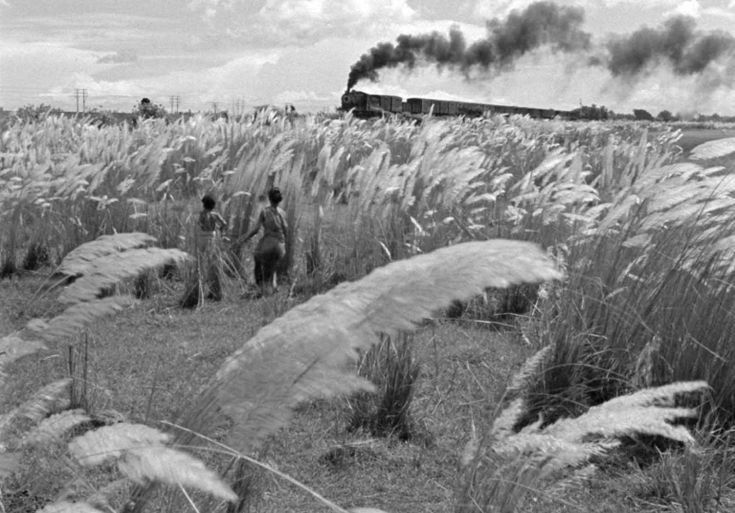
Years later, when I wanted to reconnect with my Bengali roots, I finally watched Pather Panchali.
It felt less like discovering a film and more like returning to a place I had somehow always known.
The black-and-white cinematography transforms an ordinary Bengali village into something timeless.
The ponds. The narrow pathways through the wilderness. The rustling kash fields. The monsoon rains. The humble homes.
Everything feels alive.
Like Do Bigha Zamin, the film portrays poverty honestly.
Among all the characters, the one who stayed with me the longest was Indir Thakrun, the elderly aunt.
Lonely and fragile, she reminded me of many Bengali grandmothers I had come across over the years. She also reminded me of the elderly women I encountered at old-age homes.
Often treated as an unwanted burden.
Yet carrying herself with remarkable dignity.
One of the most heartbreaking moments is when she sings Par Kore Dao More.
It feels less like a song than a quiet prayer. I often go back to listen to that heart-wrenching song.
A request to the Divine to help her cross the river of life. How sad—and how surrenderingly beautiful.
She has seen everyone else leave before her. Now she simply waits.
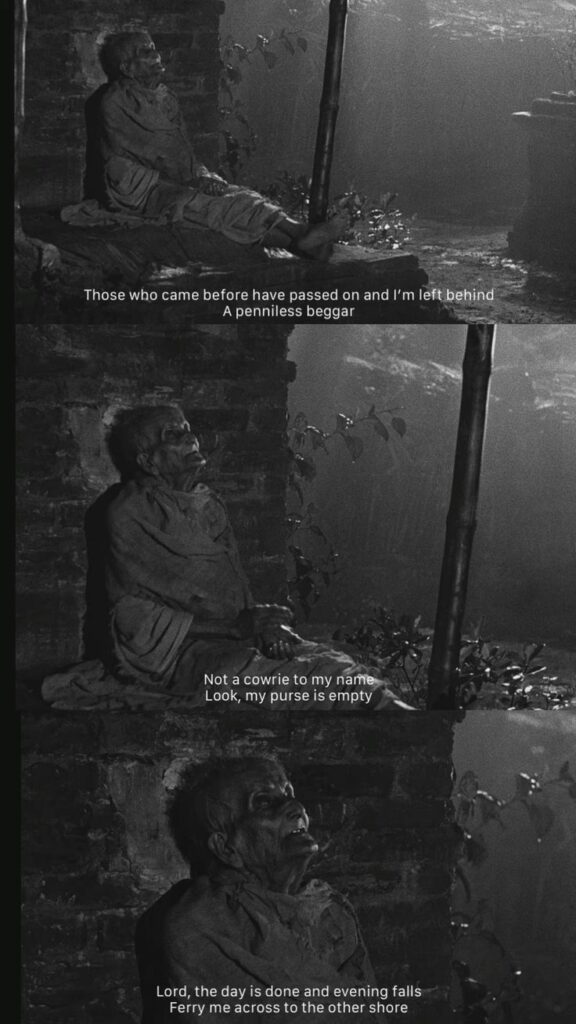
Her character portrays old age, abandonment, and quiet resilience with such compassion.
Pather Panchali is the first film in Ray’s celebrated Apu Trilogy, followed by Aparajito and Apur Sansar.
Yet I believe the first film stands perfectly on its own.
It is complete. Timeless.
A masterpiece that belongs not merely to Bengal or India, but to humanity itself.
I genuinely believe everyone should watch it, irrespective of language barriers, because great cinema always finds a way to speak directly to the heart.
Akira Kurosawa famously said of Ray’s cinema: “Not to have seen the cinema of Ray means existing in the world without seeing the sun or the moon.”
After watching Pather Panchali, I understand why.
Schindler’s List (1993) (English movie)
Oskar Schindler is one person I think of whenever I am tormented by an existential crisis. And I am grateful I watched Schindler’s List, because otherwise I might never have known that such a person existed in real life.
This holocaust drama by Steven Spielberg is based on Thomas Keneally’s Schindler’s Ark, a historical novel about Oskar Schindler, a German businessman who became an unlikely hero during the Holocaust. Initially driven by profit, Schindler employed Jewish workers in his enamelware factory. But as he witnessed the systematic persecution and murder of Jews under the Nazi regime, something in him changed. He began taking extraordinary risks to protect and save as many lives as he could.
Source: EBSCO Research Starters, “Schindler’s Ark by Thomas Keneally.”
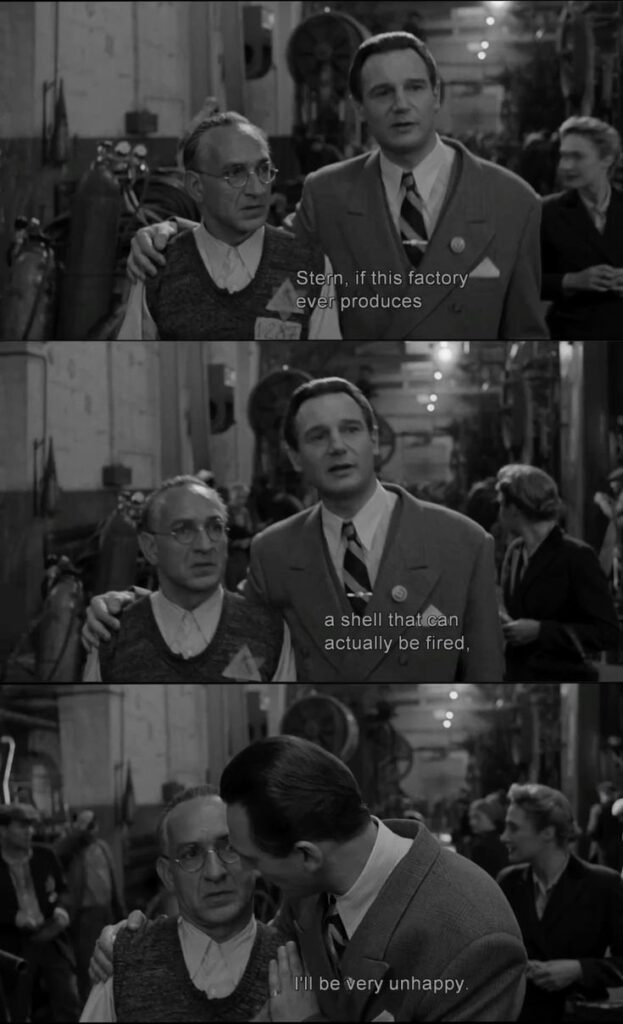
I do not have to think twice when someone asks me about my favourite movie of all time. It is Schindler’s List. It has to be.
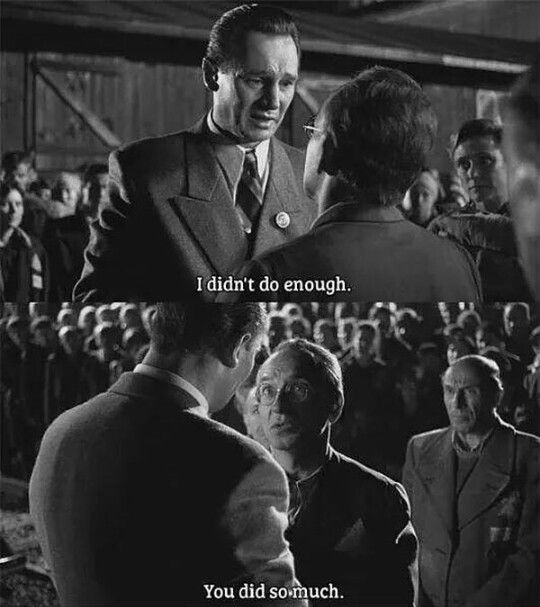
If you have watched it, you know how deeply it unsettles you. It breaks your heart into pieces and, at the same time, inspires you. It makes you question the significance a single life can have.
One life, with some privilege, can make a monumental difference in the lives of many who have none.
Why, then, do we so often fail to observe, intervene, and act when we have the ability to do so?
Movies like this force us to confront the passivity of those who can act, but choose not to-and to realise, uncomfortably, that we ourselves could be among them.
To conclude…
Stories connect us like nothing else, and these movies are bound to affect any soul that truly listens.
There are other black-and-white films that have been recommended to me and that I am yet to watch. I have also been trying to finish The 47 Ronin (Chūshingura), one of the most enduring stories in Japanese culture.
But of course, if a story speaks to you, it is yours to listen to. And no matter which medium you choose to receive stories through, what matters is the connection they create.
For now, these are the black-and-white films I would gladly recommend to anyone in search of great cinema.
I would also love to discover more, because stories allow us to step into lives beyond our own, and cinema has a remarkable way of making those lives feel immediate and real.
If you enjoy movies based on inspiring teachers, you should also check this out: FIVE OF THE MOST AMAZING TEACHERS WE HAVE SEEN ON-SCREEN